
FREE STARTER · YOUR FIRST SOURDOUGH LOAF
Bake your first loaf.
Take your Buttered Up Bakery starter from its jar to a golden, crackly loaf. Follow the cues below; most of the time is hands-off.
1. Gather a few tools.
A scale makes the recipe reliable. Your room and starter affect timing, so follow the dough as well as the clock.
- Use a digital gram scale, clear straight-sided jar of at least 500 ml, spoon, large bowl with cover, towel-lined medium bowl or proofing basket, and cooling rack.
- For baking, use a 4–6 quart Dutch oven and lid rated for 450°F (232°C), heat-rated parchment, a sharp blade, and oven mitts.
- A comfortably warm room is about 72–78°F (22–26°C). Check your pot’s instructions before empty preheating it.
2. Feed the starter until it rises well.
Use this same feeding formula each time. The bakery starter is firm and whole-wheat; repeated feeds make it softer and ready for this loaf.
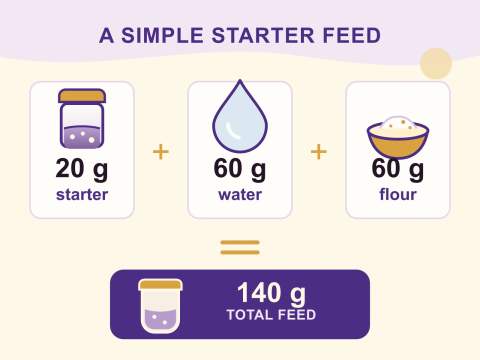
- Keep 20 g starter. Stir in 60 g room-temperature water and 60 g unbleached all-purpose flour (140 g total). Mark the level and cover loosely.
- For the first refresh, keep it at 72–78°F (22–26°C). When it rises and begins to fall, repeat the feed, keeping only 20 g each time. It may take a few feeds to double reliably.
- On dough day, use 100 g from a 140 g feed near its highest point: doubled, bubbly throughout, and rounded or just flattening. Keep 20 g for next time; discard or cook with the extra 20 g. No float test is needed.
3. Mix once, then fold three times.
Use a scale: grams of water and flour do not translate equally to cups. Sticky dough is normal; do not add flour to the mix.
- Weigh 500 g bread flour, 325 g room-temperature water, 100 g active starter, and 10 g salt.
- Stir the starter into the water. Add flour and salt; mix with a spoon and then your hand until no dry flour remains. Cover and rest 30 minutes.
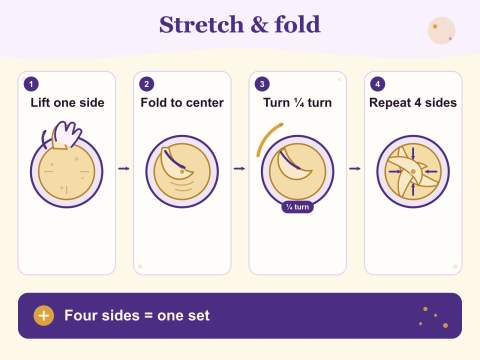
- At about 30, 60, and 90 minutes from mixing, do one set of folds. Dampen your hand; lift one side until it resists and fold it over the center. Turn the bowl and repeat on all four sides. Cover between sets; ease off if dough resists.
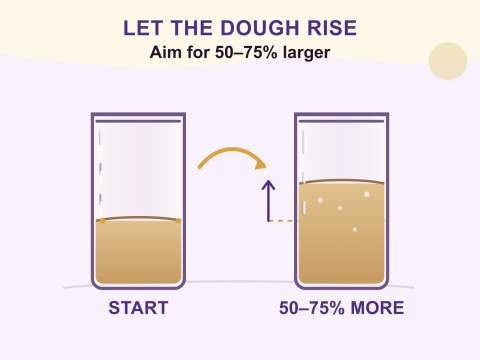
4. Let the dough rise by 50–75%.
After the last folds, keep the bowl covered and wait for the dough to look puffy and slightly jiggly, with bubbles at the edges. It does not need to double.
- At 72–78°F (22–26°C), allow roughly 4–8 hours TOTAL from initial mixing, including the rest and folds. Cooler rooms take longer; warmer rooms may be faster.
- Mark the starting level on a straight-sided container if that helps. If the dough has barely risen, keep waiting for the signs.
5. Shape tonight. Chill until tomorrow.
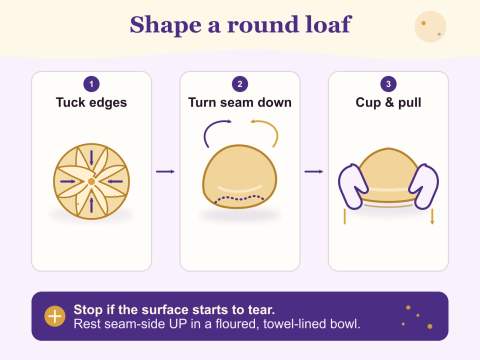
Handle the dough gently to keep some of the air from the rise.
- Lightly flour the counter and ease out the dough. Fold the edges toward the center. Turn it seam-side down; cup your hands around it and draw it toward you a few times to tighten the surface. Stop if it tears.
- Generously flour a clean towel in a medium bowl (rice flour works well). Set the dough seam-side up and cover it so it does not dry out.
- Refrigerate 8–16 hours. The next morning, bake straight from the fridge; no extra counter rise is needed.
6. Bake hot, then let it cool.
Follow the Dutch oven manufacturer’s temperature and empty-preheat limits. The pot, lid, and escaping steam get very hot; wear mitts for every touch.
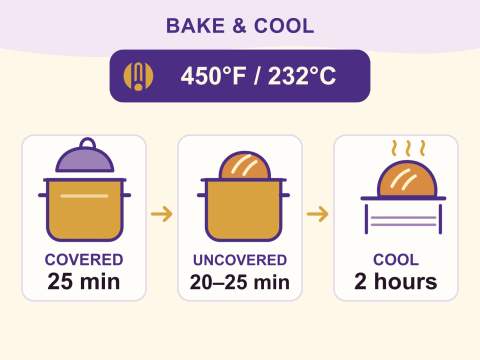
- Preheat the oven with the empty, covered Dutch oven inside to 450°F (232°C) for 45 minutes.
- Turn cold dough onto heat-rated parchment seam-side down. Score one confident slash about ½ inch (1 cm) deep. Use mitts to lower it into the pot by the parchment.
- Bake covered for 25 minutes. Remove the lid carefully and bake uncovered for 20–25 minutes, until deeply browned. If measured, the center is often 205–210°F (96–99°C).
- Move the loaf to a rack and cool at least 2 hours before slicing so the inside can finish setting.
7. Keep your starter for the next loaf.
After using 100 g in the dough, keep the saved 20 g and feed it 60 g water plus 60 g flour.
- For the fridge: after feeding, leave it loosely covered at room temperature for 1–2 hours, until a few bubbles begin. Refrigerate with a lid that is not airtight; feed about once a week.
- Before baking again, take it out 1–2 days ahead. Feed at room temperature; if sluggish, repeat the same feed about every 12 hours until it reliably doubles. Use near peak and save 20 g again.
- For a counter starter, feed about every 12 hours, keeping only 20 g before each fresh feed. A warm kitchen may make it hungry sooner.
A little help when you need it.
My starter has not doubled?
Wait in a comfortably warm place and repeat the 20/60/60 g feed as needed. Do not use a hot oven or mix the loaf until it rises reliably.
My dough is sticky?
That is normal. Dampen your hands for folds; add flour only lightly on the counter for shaping. Extra flour can make the loaf dense.
My dough has barely risen?
Keep it covered until it is 50–75% larger, puffy, slightly jiggly, and bubbly at the edges. The time range is only a guide.
My dough spreads flat. Can I still bake it?
Bake it anyway. It may have risen too long or been shaped loosely. Next time, shape a little sooner and gently tighten the surface without tearing it.
Why is the center gummy?
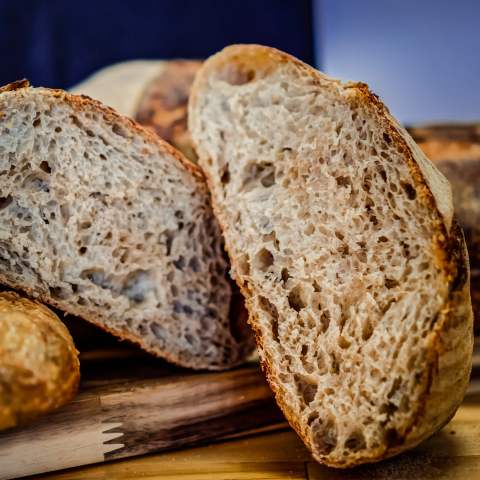
Cool the loaf for at least 2 hours before cutting, and bake until the crust is deeply browned. A weak starter or too little dough rise can also leave a dense or gummy center.
There is gray liquid or an alcohol smell?
The starter is usually hungry; stir the liquid in and feed it. If you see fuzzy mold, pink or orange streaks, or smell rot, discard all of it, wash the jar thoroughly, and get fresh starter.
Does this bread contain wheat? Yes?
It uses bread flour and a wheat starter, and sourdough fermentation does not make it gluten-free.
Your bakery is here to help.
Pick up free starter at Buttered Up Bakery. For pickup questions, call 480.750.9692.